How much time have you spent fixing your running form?
Ground contact point, cadence, knee lift angle, trunk lean, arm swing arc. Many runners invest significant time adjusting these external movement details, because the logic behind it is intuitive: find the optimal form, and efficiency will naturally follow.
In 2024, a systematic review integrating 51 studies and data from 1,115 subjects tested this assumption. The results showed that external biomechanical variables — contact time, stride length, joint angles, ground reaction forces — combined explain only 4% to 12% of the variance in running economy.
Most of the efficiency differences come from other factors.
Among Elite Runners, Efficiency Is the Real Dividing Line
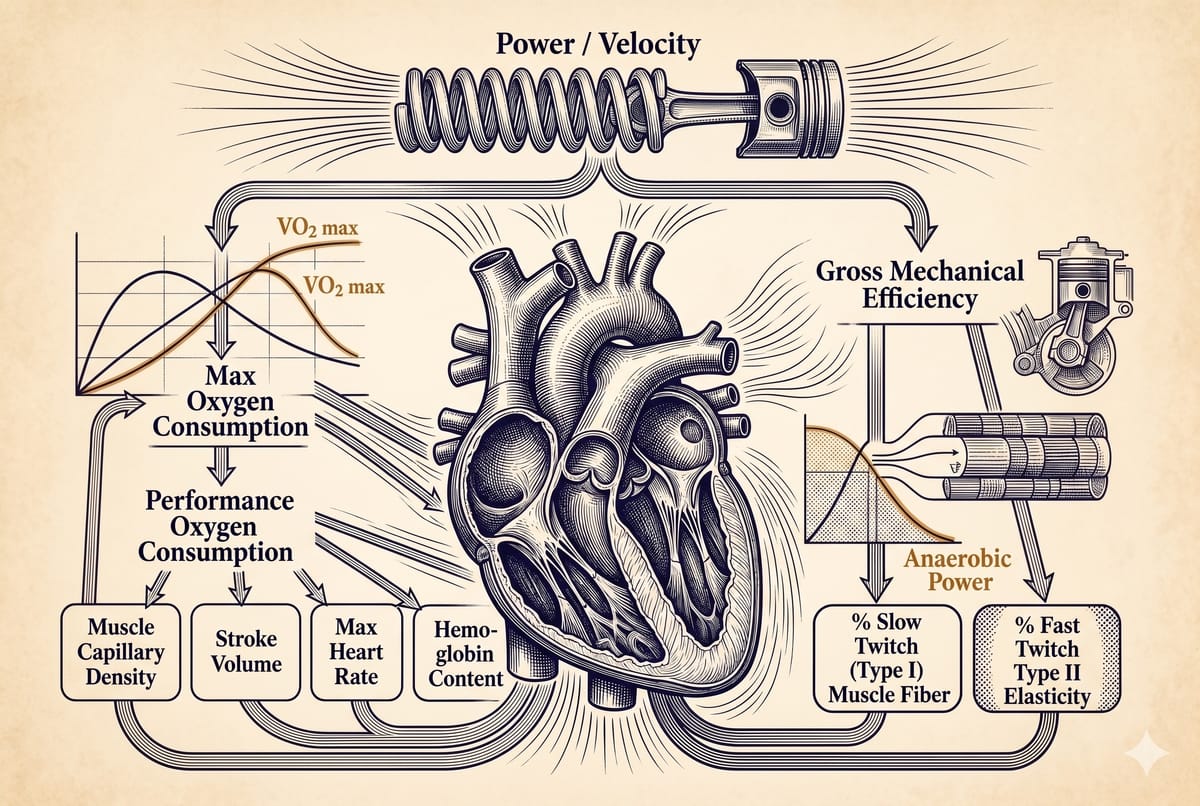
Maximal oxygen uptake (VO₂max) has long been regarded as a key indicator of endurance performance. It represents the body’s maximum capacity to deliver and utilize oxygen — the higher the value, the greater the theoretical aerobic output. Elite marathon runners typically have VO₂max values of 70 to 85 ml·kg⁻¹·min⁻¹, far above the general population. Yet among high-level runners, VO₂max differences tend to be small, and lactate thresholds also converge.
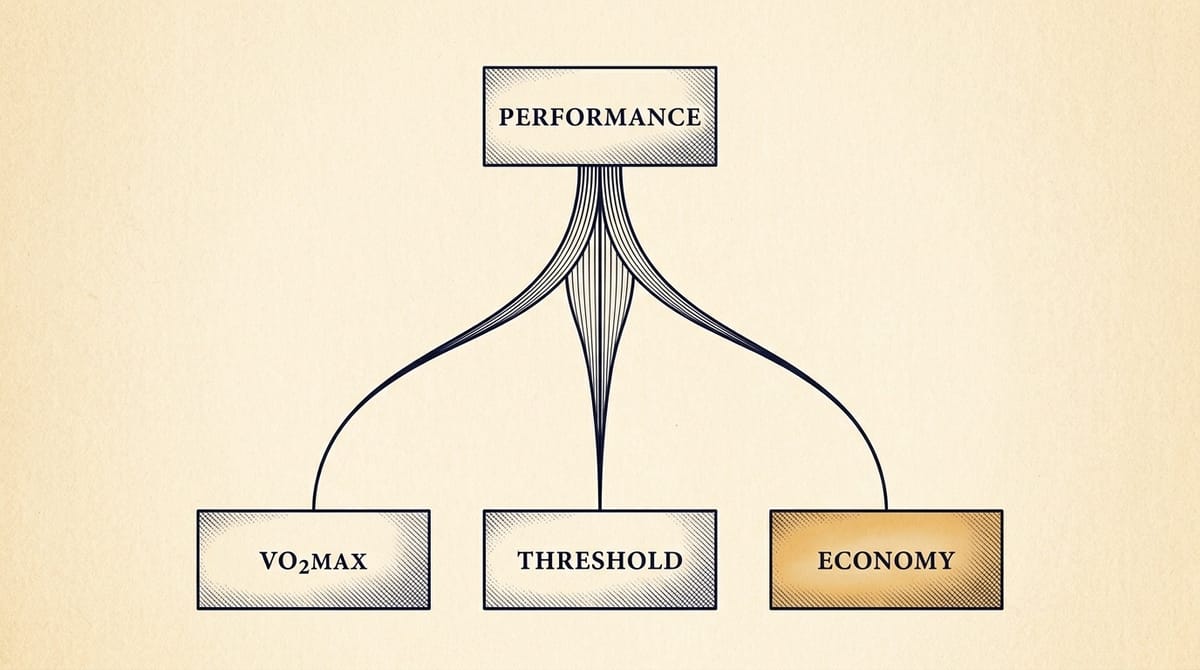
Joyner and Coyle, after integrating a large body of research in 2008, proposed that endurance performance is primarily determined by three factors:
- VO₂max
- Lactate threshold
- Running economy
Among these, VO₂max and lactate threshold show relatively limited variation within elite groups, while individual differences in running economy can reach 30 to 40%. Among runners with similar VO₂max, economy often becomes the primary source of performance differences. Improving endurance performance is not just about raising aerobic capacity — it also means reducing the energy cost of running at a given pace.
Efficiency Comes from Coordinative Structure, Not Single-Muscle Strength
Improving efficiency is often understood as strengthening the major muscle groups, but the way muscles work during running is far more nuanced. In 2021, the Bohm team used ultrasound to track fascicle behavior in the soleus and vastus lateralis during running, revealing that the two muscles adopt strikingly different strategies: the soleus operates at a moderate shortening velocity throughout the stance phase, reaching approximately 94% of its theoretical metabolic efficiency — the primary power generator; the vastus lateralis maintains near-isometric contraction, minimizing energy cost to stabilize the leg structure.
Within the same running stride, different muscles operate under different strategies. Some generate force, others maintain stability — together they form a coordinative structure orchestrated by the nervous system. Running economy reflects the overall coordination of this system, not the strength of any single muscle. A strong isolated muscle does not guarantee that the nervous system can deploy it with maximum efficiency during running.
The Achilles Tendon Shapes Soleus Efficiency
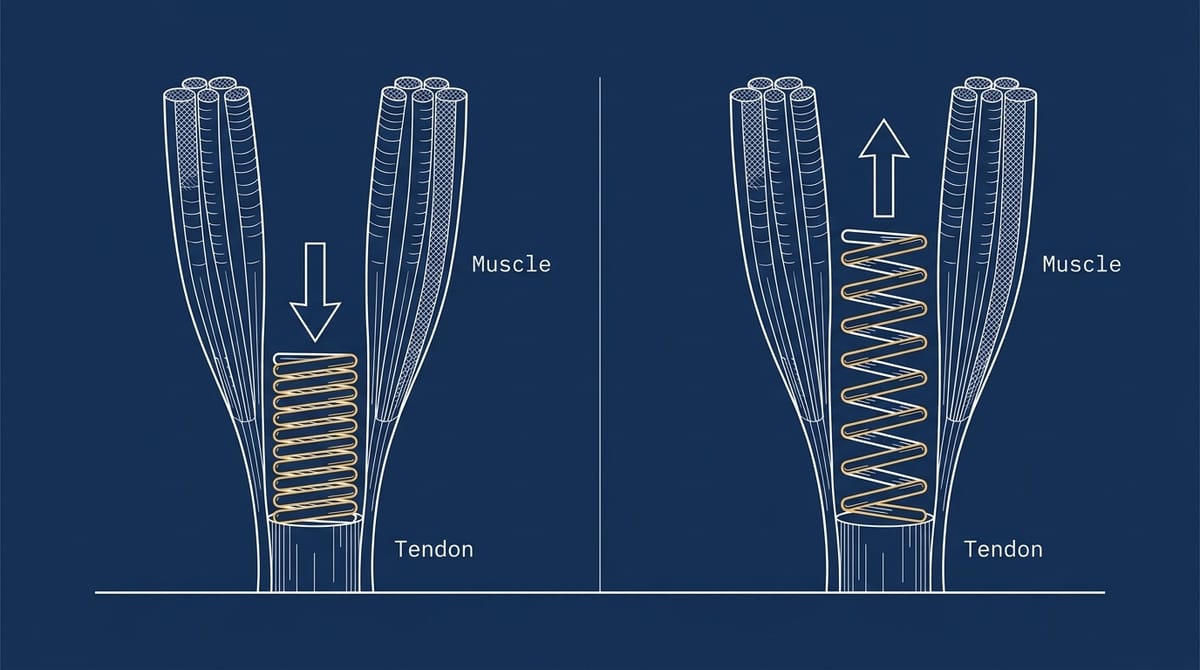
A second study by Bohm in the same year explored the relationship between tendon properties and running economy. After subjects completed 8 weeks of tendon-specific training targeting the posterior calf and Achilles tendon:
- Achilles tendon stiffness increased by 31%
- Soleus shortening velocity decreased
- Soleus work efficiency improved by 7%
- Running economy improved by approximately 4%
During running, the calf muscles and Achilles tendon form a muscle-tendon unit. Upon landing, the entire system is stretched — the Achilles tendon absorbs most of the length change, storing elastic energy and releasing it at toe-off. With greater tendon stiffness, more deformation occurs in the tendon rather than the muscle itself. The soleus fascicles can operate at a more stable length and lower shortening velocity, placing them closer to their optimal metabolic efficiency range. For the muscle, lower shortening velocity means lower energy cost; for the system as a whole, it means better running economy.
Fletcher and MacIntosh’s review found that the triceps surae accounts for approximately 25% of total oxygen consumption in elite runners, rising to as much as 40% in less-trained individuals. Soleus efficiency has a substantial impact on overall energy use, and the mechanical properties of the Achilles tendon are a key factor.
Gait Correction Cannot Directly Improve Efficiency
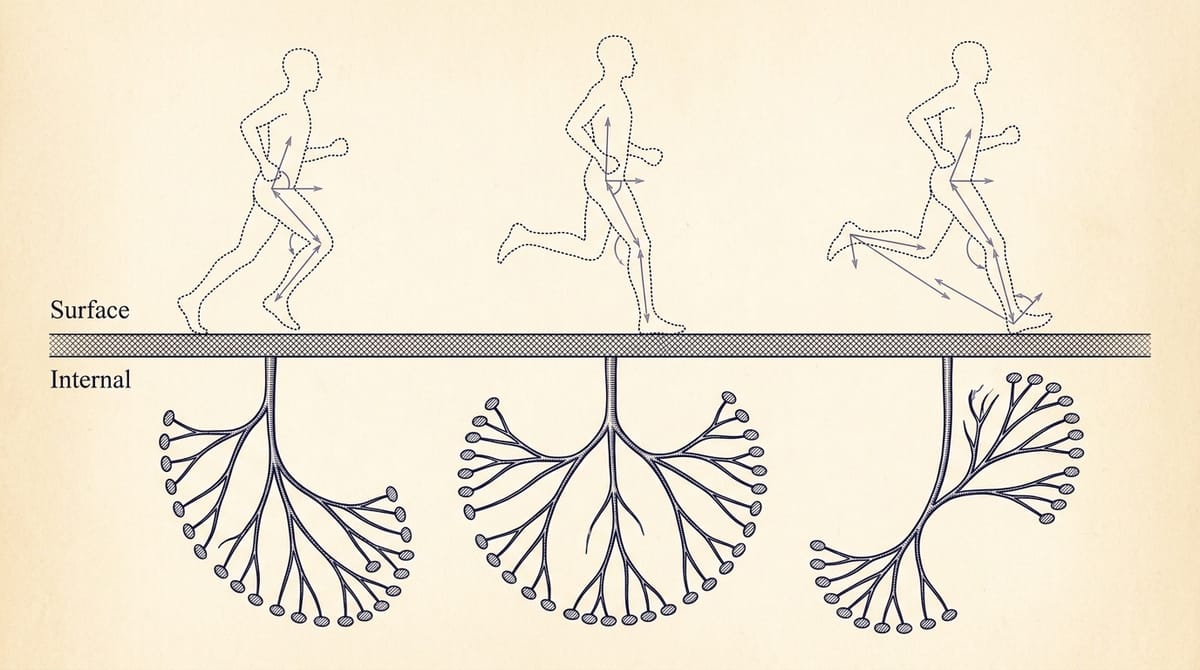
Van Hooren et al. systematically analyzed cadence, stride length, contact time, flight time, joint angles, and ground reaction forces in 2024, finding no single external biomechanical indicator capable of meaningfully explaining running economy differences. The highest correlation — cadence — showed only r = −0.20; all external biomechanical variables combined still explained only 4% to 12% of efficiency variance.
The key factors influencing efficiency include how the nervous system recruits muscles, the length and velocity at which muscles operate, and how tendons store and release elastic energy. These processes occur inside the body and cannot be directly observed from external movement patterns. External movement is the output of the internal system — different runners can use different gait patterns while sharing excellent running economy.
Efficiency Can Be Trained — Just Not the Way You Think
Bohm’s research demonstrated that tendon-specific training can alter Achilles tendon mechanical properties and improve running economy. This type of adaptation operates through different physiological mechanisms than general aerobic training — traditional endurance training primarily increases mitochondrial density, capillary density, and oxidative enzyme activity, improving aerobic metabolic capacity and lactate threshold, but not tendon mechanical properties.
Does general running volume effectively modify tendon properties? What training load is required? Does specific strength and elasticity training produce results that running alone cannot? These questions remain open, but the direction is clear: training for efficiency means targeting the operating conditions of the whole system, not isolating individual muscles.
This explains why gait correction usually fails to move the needle: you are trying to rewrite the system’s output without touching the underlying structure that produces it. The point of entry is the system’s constraints — not the shape of the movement.
Dynamical Systems Theory approaches efficiency from exactly this angle — understanding how economy emerges and converges at the system level through self-organization. It remains one of the most promising research frameworks for understanding running economy today.
References
- 1. Van Hooren, B., Jukic, I., Cox, M., Frenken, K.G., Bautista, I., & Moore, I.S. (2024). The Relationship Between Running Biomechanics and Running Economy: A Systematic Review and Meta-Analysis of Observational Studies. Sports Medicine, 54(5), 1269–1316. ↗
- 2. Joyner, M.J., & Coyle, E.F. (2008). Endurance exercise performance: the physiology of champions. The Journal of Physiology, 586(1), 35–44. ↗
- 3. Bohm, S., Mersmann, F., Santuz, A., Schroll, A., & Arampatzis, A. (2021). Muscle-specific economy of force generation and efficiency of work production during human running. eLife, 10, e67182. ↗
- 4. Bohm, S., Mersmann, F., Santuz, A., & Arampatzis, A. (2021). Enthalpy efficiency of the soleus muscle contributes to improvements in running economy. Proceedings of the Royal Society B: Biological Sciences, 288(1943), 20202784. ↗
- 5. Fletcher, J.R., & MacIntosh, B.R. (2017). Running Economy from a Muscle Energetics Perspective. Frontiers in Physiology, 8, 433. ↗
If this article was helpful, feel free to buy me a coffee ☕ and keep me writing.