
Running form is not an appearance you can adjust — it’s what happens when your entire movement system operates under a specific set of conditions. Understanding this changes the direction of training completely.
Many runners spend months on squats, lunges, and lower-body strength work. They get stronger. Their stability improves. But their running doesn’t fundamentally change. The easy explanation is that they haven’t learned the technique properly. The more accurate one: running movement isn’t built from understanding or stacking local capacities. It self-organizes from the nervous system operating in context.
A Neglected Question
The logic behind running form coaching goes like this: your movement is flawed, learn the correct way, and you’ll run differently. This assumes running form is a technology that can be directly installed — like learning to ride a bike, something that once acquired stays fixed.
The problem is that running movement doesn’t work that way at all.
In 1947, Soviet biomechanist Nikolai Bernstein published On the Construction of Movements. The book was suppressed for nearly two decades under Soviet political conditions. It wasn’t until 1967, when Pergamon Press released the English collection The Co-ordination and Regulation of Movements, that Western movement science began to reckon with a core question it had long ignored: how is the coordination of human movement actually organized?
Bernstein’s central framework, the “Levels of Construction of Movements,” doesn’t ask how to produce correct movement. It asks why the body — given an enormous number of degrees of freedom — can still generate stable, repeatable motion. The human body has hundreds of joint degrees of freedom; any given movement could theoretically be completed in countless ways. Yet movement isn’t chaotic. The nervous system organizes and constrains those degrees of freedom across multiple levels, making movement controllable and functional.
His answer wasn’t “the brain issues commands.” It was: movement emerges from five neural levels cooperating, self-organizing within the constraints of environment and task. Running form is the result of that process.
Level A: The Foundation Layer
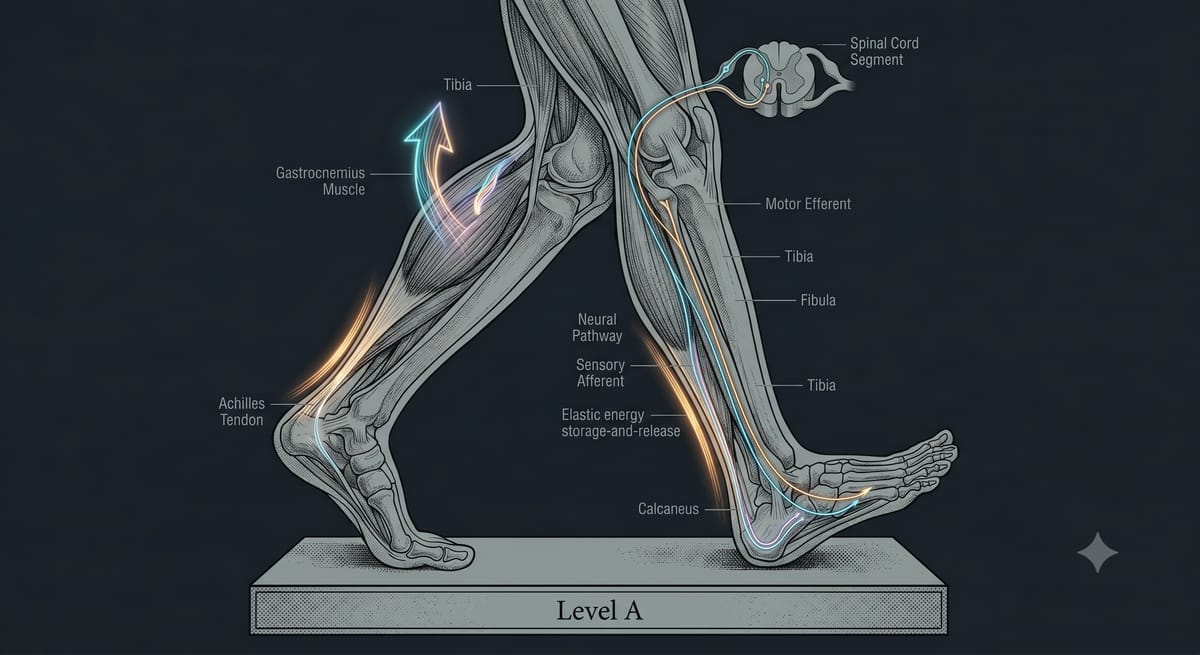
The lowest level in Bernstein’s framework — Level A, the rubro-spinal level — is evolutionarily the most ancient motor layer, present even in fish.
This level governs baseline muscle tone regulation, reflex control, and the immediate responses of elastic tissue. You don’t fall over standing still not because you’re actively trying to stay upright, but because this level continuously adjusts baseline muscle tone throughout your body. The Achilles tendon storing elastic energy at footstrike and releasing it on push-off — that also happens here.
Level A corresponds to the body’s structural capacities: muscle fiber force output, Achilles tendon stiffness, the speed at which muscles respond to load. Strength training that improves force output, tendon stiffness, or local stability is changing the capability base at this level. Squats make the quads stronger. Lunges stabilize hip strength. Calf work increases tendon elasticity. These gains are real, and they affect running performance. But they are not the same as running movement. Level A is the foundation of the system. The foundation isn’t the building.
Level B: The Synergy Layer
One level up is Level B — the level of synergies — corresponding to the thalamus and globus pallidus.
This level organizes multiple muscle groups into stable movement patterns: synergies. Upper and lower limbs form coupled timing relationships. Arms and legs coordinate within a shared rhythm. The trunk maintains balance through continuous weight transfer. This is what we call running form.
Level B has several properties that explain why running form is so resistant to change.
First, it uses the body itself as its coordinate system. The sensory signals this level processes are joint angles, limb velocities, and whole-body proprioception — the body’s internal language. The movement goal is maintaining coordination, not responding to external space. Bernstein called this category of movement “propriomotor.”
Second, Level B patterns are highly stable and largely insensitive to conscious intervention. Once a synergy is established, it’s very difficult to rewrite. A coach says “lift your knees higher,” you respond briefly, but the adjustment doesn’t hold past three kilometers. The layer where conscious commands operate is not the same layer that controls movement stability.
Third, change at this level can only happen within a movement context. Level B synergies self-organize gradually through repeated sensory-feedback loops, and can only be reshaped through actual movement — they can’t be built by proxy through substitute exercises disconnected from the original context.
Strength Training Speaks a Language Level B Doesn’t Understand
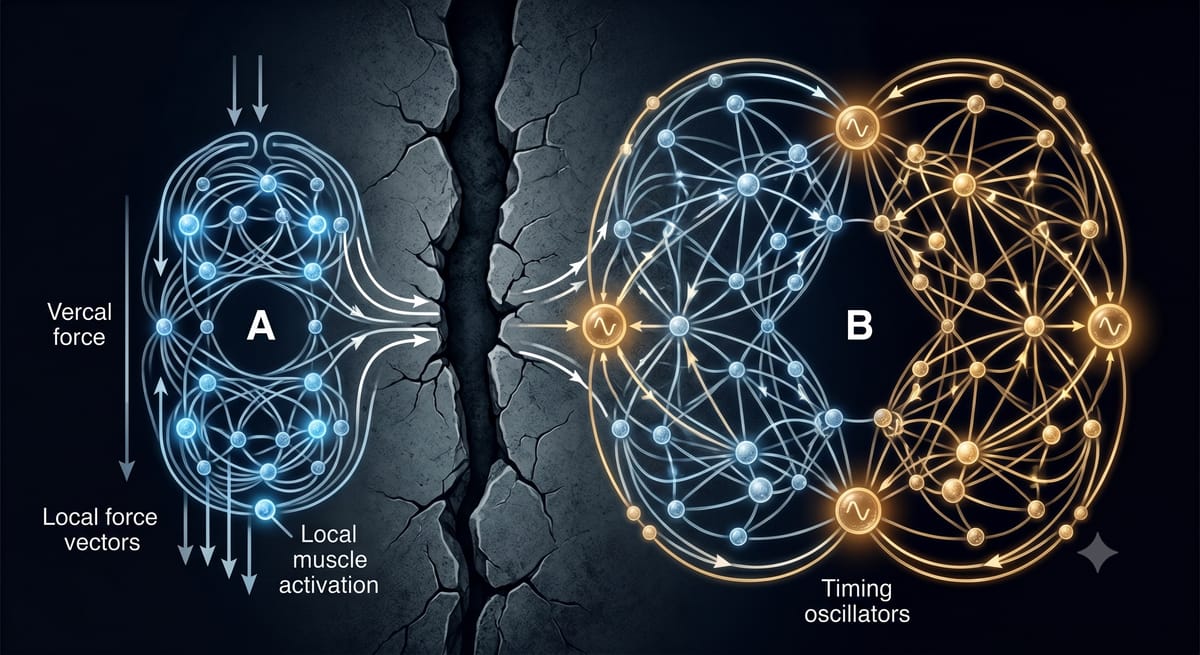
This is the core problem of transfer.
Level A’s neural computation language is: how much force does this muscle need, at what speed, with what tension. A squat’s neural language is “lower-limb extension synergy under vertical load.” Level B’s language is: what is the body’s overall state in space right now, what is the coordination ratio between left and right sides, how much output do I need to regulate rhythm for the next ground contact.
These two languages live in different locations anatomically. They have different sensory inputs and different organizational logic. A well-executed squat genuinely improves Level A. But that improvement does not automatically reorganize Level B’s synergy patterns. It’s like installing better engine components without recalibrating the drivetrain — you have more power, but the dynamic coordination of the whole vehicle hasn’t changed.
This isn’t “strength training is useless.” It’s that the effects of strength training are being assigned to the wrong layer.
How Level B Changes
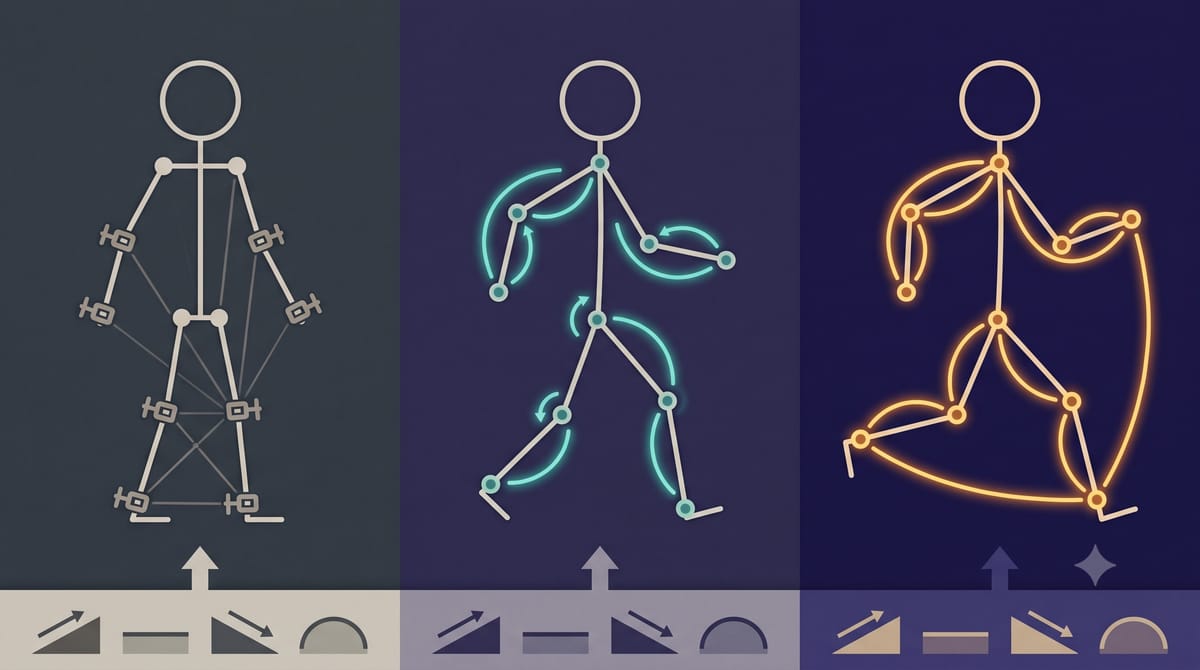
Bernstein described a process in Chapter 8: when a beginner faces a complex movement, they naturally freeze joint degrees of freedom — trading stiffness for controllability. The first time someone runs, the arms barely swing, the shoulders are tight, stride length is short, cadence is irregular. That’s the state before Level B has established any synergy.
As practice accumulates, those frozen degrees of freedom gradually unfreeze and integrate into the overall synergy pattern: the arms begin swinging rhythmically without conscious thought; cadence stabilizes automatically; the trunk finds its forward lean angle. The critical variable is movement practice within a running context — not all forms of practice have equivalent effects.
A 2020 baseball batting study (Gray, 2020) measured this directly. Researchers compared two groups: one practicing under fixed conditions, one under high-variability conditions — different pitch speeds, different locations. The high-variability group showed significantly greater improvement in batting synergies, and higher “good variability” — adaptive fluctuation within task constraints. That’s what Bernstein meant by skill: not more consistent movement, but movement that adapts more flexibly to variation.
The logic transfers directly to running. Practice on hills, descents, turns, and uneven surfaces gives Level B richer sensory feedback material than single-pace flat running. These varied terrain and rhythm changes continuously alter ground contact time, weight transfer patterns, and muscle recruitment ratios — the synergy is repeatedly organized and adjusted across a wider range of constraints.
The variable that matters isn’t training volume. It’s the richness of the movement context. When the body enters “running” repeatedly under varied dynamic conditions, the synergy structure Level B depends on stabilizes across diverse feedback — rather than being locked into a fixed pattern built for one environment.
Do Running Form Classes Actually Work?
To be fair, some things do work. Improving Level A is meaningful — stronger glutes and legs give Level B better hardware to work with. Strength training and gym work accomplish that.
Conscious movement guidance, in Bernstein’s framework, belongs to Level C — the spatial field level. Cues like “land directly under your center of mass” use external spatial coordinates to guide movement, and they have some short-term effect on movement correction. But for Level C instructions to penetrate Level B’s deeper synergy patterns, they require large amounts of repetitive practice under conscious guidance — slowly shaping Level B from above.
The problem isn’t that form classes have no effect. It’s that when the theoretical framework is wrong, the explanation of why things work is also wrong. “I teach you correct form, you learn it, you run better” — that causal chain is backwards. What actually happens: the class provided movement practice within a running context, and Level B gradually self-organized a more efficient pattern through repeated sensory-feedback loops. The driver was “exploring movement in the right context,” not “knowing what good form looks like.”
Understanding that difference tells you where to put your time and energy.
What Your Running Form Is Telling You
Running form analysis still has value — but the value isn’t in “correcting movement.” It’s in understanding the current state of the movement system.
Level A status: is hip drive strong enough? Is Achilles elastic energy storage being utilized? Is landing impact absorbed by muscle or transmitted through bone? These are visible in running form. The intervention is targeted strength training, not “teaching knee lift.”
Level B maturity: is left-right coordination sufficient? Is stride rhythm stable? Are upper and lower limb swings working together? The intervention is varied practice within a running context — different terrain, different speeds, different goals — giving Level B enough rich sensory feedback to self-organize.
What you do after a gait analysis is different from what most form classes teach.
The Logic of Running
The human body is a complex system, not a machine that accepts programming. Running training runs in two different directions: one is improving the body’s output and structural capacity — strength, tendon stiffness, fundamental stability. The other is letting the movement system continuously adjust within actual running contexts, allowing synergy patterns to gradually take shape and stabilize. The first provides the conditions. The second determines the form.
Running form changes primarily in the second process. It isn’t directly taught — it gradually emerges after repeated running at different speeds, on different terrain, under different fatigue states. What you can do is build the Level A hardware, then let Level B self-organize across varied running contexts. Good form appears as the outcome.
Next time someone talks about “improving running form,” the question isn’t whether movement is being corrected. It’s whether the intervention is aimed at the right level.
If the answer is only “teach you correct movement technique,” it may still be at the surface. Because the real question isn’t what the movement looks like — it’s how that movement is being organized inside your body.
References
- 1. Bernstein, N. A. (1947/2021). Bernstein's Construction of Movements: The Original Text and Commentaries (M. L. Latash, Ed.). Routledge. ↗
- 2. Bernstein, N. A. (1967). The Co-ordination and Regulation of Movements. Pergamon Press. ↗
- 3. Bongaardt, R., & Meijer, O. G. (2000). Bernstein's theory of movement behavior: historical development and contemporary relevance. Journal of Motor Behavior, 32(1), 57–71. ↗
- 4. Gray, R. (2020). Changes in movement coordination associated with skill acquisition in baseball batting. Frontiers in Psychology, 11, 1295. ↗
- 5. Hafkamp, M., Casanova, R., & Bootsma, R. J. (2023). Freezing and freeing of degrees of freedom in joint action learning. Frontiers in Psychology, 14, 1287148. ↗
- 6. Spencer, J. P., Perone, S., & Buss, A. T. (2011). Twenty years and going strong: a dynamic systems revolution in motor and cognitive development. Child Development Perspectives, 5(4), 260–266.
If this article was helpful, feel free to buy me a coffee ☕ and keep me writing.