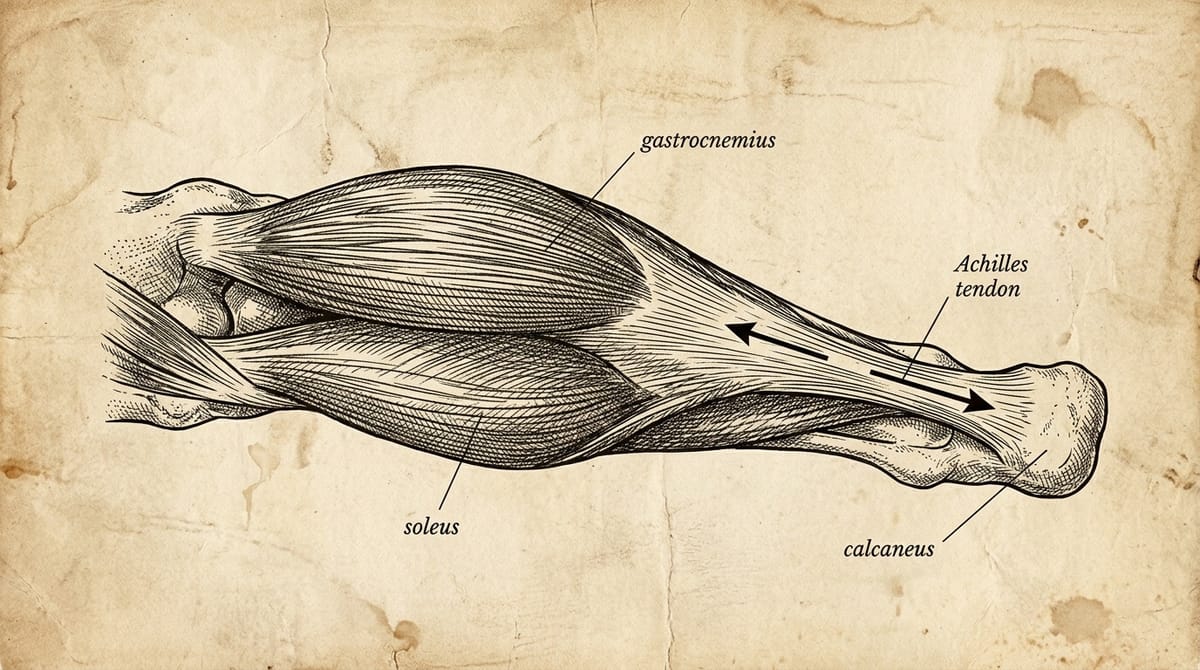
At the moment of landing, your Achilles tendon bears a force roughly six to eight times your body weight. That number usually shows up in injury-prevention discussions — but it points to something more interesting: the Achilles tendon doesn’t just absorb impact. It’s one of the primary determinants of how efficient your running is.
The usual explanation is the spring model: the tendon stores elastic energy on landing and releases it during push-off. That’s true, but it undersells the real story. The Achilles tendon’s most important contribution to running economy isn’t energy recycling — it’s changing how the muscles work, keeping them in a lower-cost operating state at every single step.
The Tendon Doesn’t Generate Force — It Transmits It
The Achilles tendon connects the calcaneus to the soleus and gastrocnemius in a series arrangement. In a series connection, force is equal throughout the chain at any given moment — whatever force the muscle generates, the tendon bears.
The tendon has no contractile tissue. It can’t add force. So how much elastic energy it stores depends on exactly two things: how much force the muscle produces, and how much the tendon deforms under that force.
But chasing maximum energy storage isn’t the goal. The tendon’s more consequential function is absorbing the length change of the entire muscle-tendon unit — so the muscle fascicles themselves barely have to move.
The Tendon Moves So the Muscle Doesn’t Have To
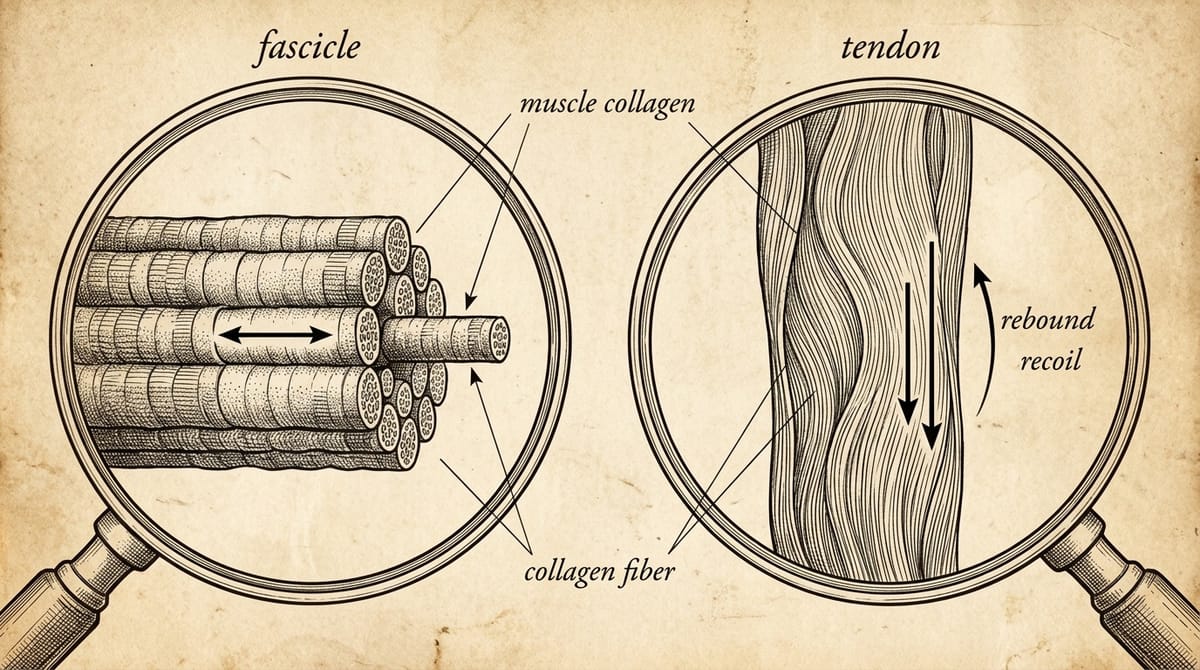
The intuitive picture of running is force transmission: muscle contracts, pulls tendon, rotates joint, pushes body forward. Ultrasound imaging has revealed something more sophisticated.
In 2001, Fukunaga and colleagues used real-time ultrasound to track fascicle behavior in the medial gastrocnemius during walking. Throughout the stance phase, fascicle length barely changed — only minor variation. The Achilles tendon, meanwhile, lengthened roughly 7 mm and snapped back during push-off.
The muscle-tendon unit was changing length. But the tendon was absorbing nearly all of it.
Why does this matter? Because concentric contraction — muscle shortening — is the most metabolically expensive mode of muscle work. If the tendon absorbs the length change, the fascicles can remain near isometric: continuously generating force without extensively shortening. Roberts and colleagues synthesized multi-species data in 2002 to make this explicit: tendons allow muscles to operate at their own preferred velocity even while the whole muscle-tendon unit is changing length rapidly. The muscle generates force; the tendon manages length and stores energy.
Contraction Velocity Determines Metabolic Cost
The reason near-isometric work is so valuable is that muscle metabolic cost is tightly coupled to contraction velocity.
In 1997, Ryschon and colleagues measured efficiency of human skeletal muscle directly in vivo across different contraction modes. Concentric contraction — shortening — had the highest metabolic cost. Isometric contraction had the lowest. Eccentric contraction (lengthening while generating force) was substantially cheaper than concentric.
Faster shortening means more ATP consumed. Running requires generating force repeatedly at every step — if every step demands rapid muscle shortening, the metabolic tab climbs. The Achilles tendon’s function is to keep the muscle in the low-cost operating zone as much as possible.
Optimal Stiffness — Not Maximum Stiffness
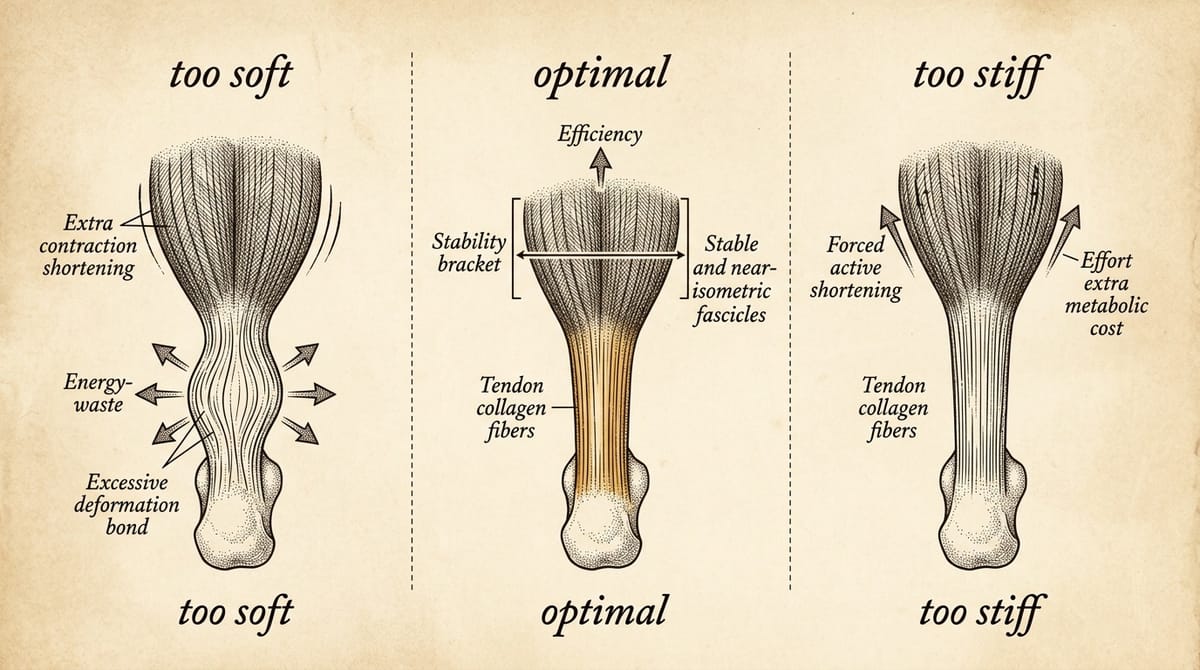
“Stiffer tendon, better running economy” — that’s half right. What matters isn’t maximizing stiffness; it’s finding the right range for your own mechanics.
A tendon that’s too compliant deforms too much, reducing elastic energy return efficiency. A tendon that’s too stiff can’t absorb enough length change, forcing the muscle to take on more work. The optimal state is one where the tendon absorbs most of the unit’s length change while the fascicles stay near isometric or low-velocity contraction.
Lichtwark and Wilson built a computational model in 2007 showing that the tendon stiffness that maximizes gastrocnemius efficiency is around 150 N/mm for walking and around 250 N/mm for running. Subsequent research has found a fairly wide optimal plateau — roughly 150–500 N/mm — where efficiency stays near maximum. The target isn’t the hardest possible tendon; it’s a tendon stiff enough to store and return energy effectively while letting the muscle do its job efficiently.
Soleus and Gastrocnemius Work Differently
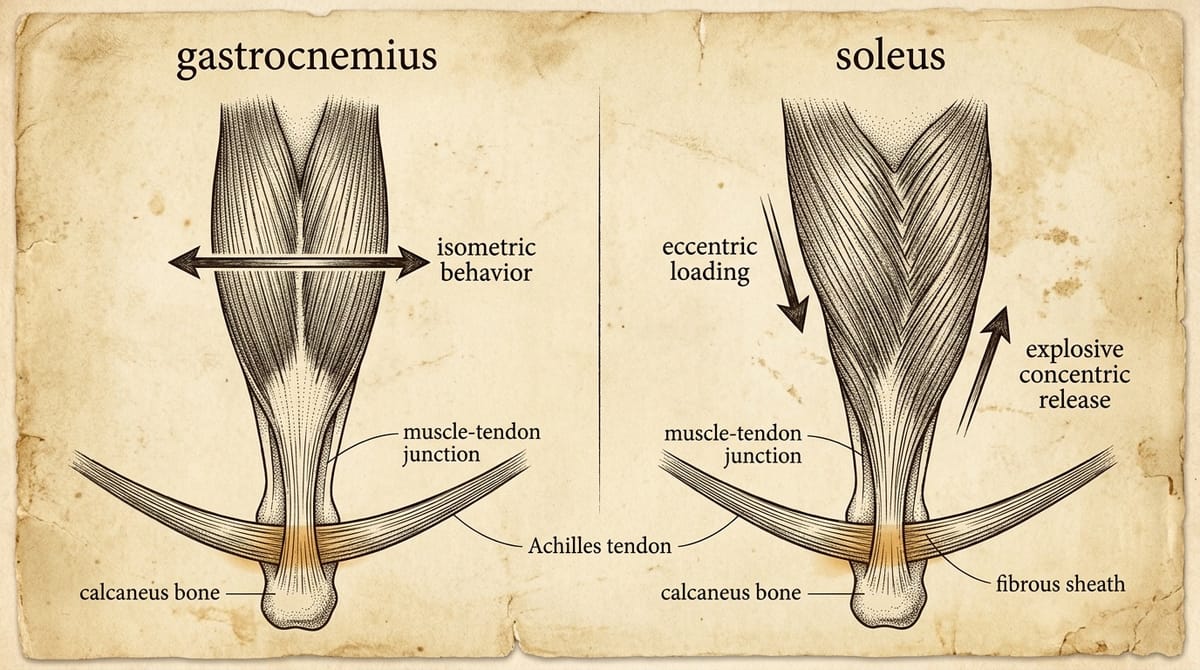
Both the soleus and gastrocnemius attach via the Achilles tendon and both contribute to propulsion — but they don’t work the same way.
Ishikawa and colleagues tracked fascicle behavior in both muscles simultaneously during walking in 2005, using fiber-optic sensors to measure tendon force directly. The finding: the medial gastrocnemius fascicles remained roughly isometric through the stance phase — continuously generating force without extensive shortening. The soleus, by contrast, was progressively stretched through stance, building up tension, then rapidly shortened during push-off.
The researchers called this the “catapult action.” It isn’t a passive spring. The sequence is: muscle actively generates force → tendon stores energy → energy releases at the right moment. The muscle controls the force; the tendon manages the storage and release. This division of labor is what sustains efficiency across the duration of a long run.
Training Can Change Tendon Stiffness — and Running Economy
If tendon stiffness shapes running economy, can training shift it? Yes.
Bohm and colleagues published a 14-week tendon training intervention in Proceedings of the Royal Society B in 2021. Twenty-three recreational runners were enrolled. Results: tendon stiffness increased roughly 31%, calf strength increased about 10%, and running metabolic cost dropped around 4%.
The mechanism was visible in the data: after training, soleus fascicle shortening velocity during running decreased — the muscle was working closer to isometric, consuming less ATP per step. Tendon stiffness rose, muscle velocity fell, energy cost dropped.
The caveat matters though. More stiffness isn’t always better. If a runner’s tendon is already in the optimal range, pushing stiffness further yields diminishing returns. The training benefit is largest for runners whose tendons are currently too compliant — not for those who are already near the optimal window.
What the Achilles Tendon Is Actually Saving
Running metabolic cost is, at its core, sustained ATP consumption. Every time a muscle generates force, maintains tension, or changes length, it draws on energy supply.
The Achilles tendon’s contribution is letting the muscle do the same mechanical work at lower metabolic cost:
- Reducing the demand for rapid muscle shortening
- Shifting the muscle away from expensive concentric contractions
- Keeping fascicles near isometric or low-velocity operation
Elastic energy storage and return is real — but it’s worth keeping separate from this other function. Energy recycling is a mechanical contribution. Reducing muscle contraction velocity is the metabolic one. Roberts and Azizi catalogued four tendon functions in their 2011 review: improving metabolic efficiency, amplifying power output, absorbing impact, and transmitting force rapidly. For distance runners, the metabolic efficiency function is likely the most significant — the one that compounds across thousands of steps.
Finni and Vanwanseele, reviewing fifty years of Achilles tendon research in 2023, compressed the concept to a single sentence: the tendon reduces the demand on muscles for ATP by lowering the velocity at which they must shorten.
The Achilles Tendon Is a Regulator, Not a Passive Spring
Better running economy isn’t only about more mileage or a higher VO₂max. The coordination between muscle and tendon determines the efficiency of every single step.
Heel raises, eccentric loading, plyometrics, and targeted strength work can progressively improve the tendon’s capacity to bear force and return energy. But tendon adaptation is slow — much slower than muscle. Weeks to months may pass before changes in stiffness translate into measurable shifts in running economy.
The most efficient runners aren’t just stronger. They’re better organized — muscle and tendon each doing their own job, neither compensating for the other.
Muscle generates force.
Tendon stores and returns it.
The Achilles tendon regulates how that force gets used — and it’s doing it at every step.
References
- 1. Fukunaga T, Kubo K, Kawakami Y, Fukashiro S, Kanehisa H, Maganaris CN. In vivo behaviour of human muscle tendon during walking. Proceedings of the Royal Society B: Biological Sciences. 2001;268(1464):229–233. ↗
- 2. Roberts TJ. The integrated function of muscles and tendons during locomotion. Comparative Biochemistry and Physiology Part A: Molecular & Integrative Physiology. 2002;133(4):1087–1099. ↗
- 3. Ryschon TW, Fowler MD, Wysong RE, Anthony A, Balaban RS. Efficiency of human skeletal muscle in vivo: comparison of isometric, concentric, and eccentric muscle action. Journal of Applied Physiology. 1997;83(3):867–874. ↗
- 4. Lichtwark GA, Wilson AM. Is Achilles tendon compliance optimised for maximum muscle efficiency during locomotion? Journal of Biomechanics. 2007;40(8):1768–1775. ↗
- 5. Ishikawa M, Komi PV, Grey MJ, Lepola V, Bruggemann GP. Muscle-tendon interaction and elastic energy usage in human walking. Journal of Applied Physiology. 2005;99(2):603–608. ↗
- 6. Bohm S, Mersmann F, Santuz A, Arampatzis A. Enthalpy efficiency of the soleus muscle contributes to improvements in running economy. Proceedings of the Royal Society B: Biological Sciences. 2021;288(1943):20202784. ↗
- 7. Roberts TJ, Azizi E. Flexible mechanisms: the diverse roles of biological springs in vertebrate movement. Journal of Experimental Biology. 2011;214(3):353–361. ↗
- 8. Finni T, Vanwanseele B. Towards modern understanding of the Achilles tendon properties in human movement research. Journal of Biomechanics. 2023;152:111583. ↗
If this article was helpful, feel free to buy me a coffee ☕ and keep me writing.